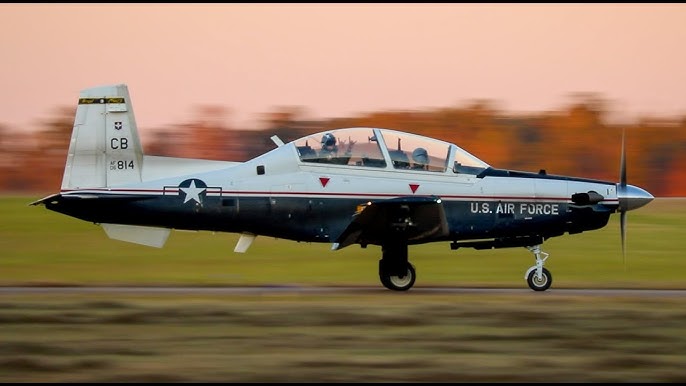
There’s no easing into flying when you’re learning to become a U.S. Air Force pilot.
The first time I strapped into the T-6 Texan II, it felt like standing at the edge of a cliff — helmet tight, heart hammering, and 1,100 horsepower rumbling beneath me. Every part of me buzzed with adrenaline. This wasn’t a simulator anymore. This was real. And I was in the front seat.
The T-6 looks sleek on the ramp, almost like a sports car for the sky. But it’s not just built for looks — it’s designed to push you, to test your instincts, and to show you exactly where you need to get stronger. That first day, I found out just how serious it was.
The Start Line: Pre-Flight Jitters
Walking out to the aircraft with my instructor felt surreal. Even with weeks of academics and chair-flying behind me, nothing truly prepares you for the moment you touch the real stick and throttle.
The T-6 cockpit wraps around you like a glove — tight, clean, full of dials and glass screens. The harness locked me in so snugly I could barely move, and the helmet sealed the world outside into a muted hush.
There was a quick canopy check. “You ready?” my instructor asked casually through the intercom.
“Ready,” is what I was hoping I clearly said, but that was muted by my heavy, awkward mouth breathing into the mask.
Throttle Up and Wheels Up
The throttle slid forward. The T-6 came to life.
Acceleration pinned me back against the seat as we barreled down the runway, the nose lifting sharply toward the cloud peppered Mississippi sky. The mains lifted, and suddenly — I was flying.
We flew off to a training box in the sky, my instructor calmly said the words I’ll never forget:
“Alright, ready for G’s?”
The G-forces hit me like a sledgehammer — 3, maybe 4 Gs. Everything went from vibrant color to dulling gray in an instant. My instructor came over the intercom with “4 G’s feeling good…” My response:
“4 uh, G’s, feeling something!”
After a brief reprieve to regain my composure, it was time to roll and pull, to see what this aircraft was capable of. The trees, clouds, and sky all spun together. For a moment, all I could do was laugh inside my oxygen mask. This was real. This was happening.
Learning to Think While Flying
It wasn’t just aerobatics for the fun of it, though — every move had a purpose.
In UPT, they start you in aerobatics to teach you energy management: how to control your aircraft’s speed, altitude, and attitude intuitively. It builds instincts that later translate into formation flying, emergency recoveries, and combat maneuvers.
Even basic maneuvers like loops and barrel rolls quickly led into more complex tasks:
- Practicing recoveries from unusual attitudes
- Holding precise airspeeds in climbing and descending turns
- Coordinating stick and rudder through slow flight
- Staying ahead of the aircraft, mentally and physically
Each sortie wasn’t just about surviving the ride — it was about processing faster, thinking further ahead, and tightening up every movement into something deliberate and smooth.
Flying fast is easy. Flying smart? That’s what UPT is really about.
First Lessons, First Humbles
By the end of the flight, I was drenched in sweat.
I’d missed a few radio calls. I’d fumbled through a G exercise. I probably looked like a confused octopus trying to work the radios, the stick, the rudder, the power settings all at once.
But I was smiling like an idiot under my oxygen mask because I was flying, and nothing could touch that feeling.
That first sortie cracked open a whole new world. Every flight after layered new skills on top — building the building blocks that would eventually lead to formation flying, instrument approaches, and low-level navigation. Each block mattered. Each sortie counted.
It was the beginning of what would become, truly, a journey of Clear Skies and Wild Rides.
And as tough as it was, I knew even then: I was exactly where I was supposed to be.
Next Up:
➡️ “Weathering the Storm: Tornadoes, Snow, and Ice at Columbus AFB” — where bad weather wasn’t just an obstacle… it became part of the training.
 JetSetGOConnor
Hi Michael,
This post is incredible. Wow! I just read it twice. You write beautifully. Thank you so much for sharing.
Kim 😊
LikeLiked by 1 person
Thank you so much, Kim—your words truly mean a lot. I’m really glad the post resonated with you! Writing about that first flight brought back so many vivid memories, and hearing that it connected enough for you to read it twice is the highest compliment I could ask for. Thanks for taking the time to read and share your thoughts—it encourages me to keep telling these stories. 😊✈️
LikeLiked by 1 person
Hi Michael,
You’re so welcome.
Now that I’m getting these emails of your posts, I find that I can more easily read them, then finding them on Instagram. I’m old school, and afraid if I get on Instagram too often, I will be on there forever, and get nothing done. Lol This way, I see your emails, when I go through them daily, and it’s like reading a great book.
Thank you for that.
Kim 😊
LikeLiked by 1 person
Hi Kim,
That truly means so much—thank you for sharing that with me. I’m really glad the emails are making it easier and more enjoyable to stay connected. I completely understand what you mean about Instagram—it’s easy to get pulled in and lose track of time! There’s something special about slowing down and reading something with intention, and if my posts feel anything like opening a good book, then I’m deeply honored.
It means the world to know that these stories are resonating with you. Thank you for reading, for supporting, and for being part of this journey.
With gratitude,
– Michael ✈️
LikeLiked by 1 person